 Elevon in Forbes
Nine Workgroups Piloting AI, Eight Realizing No Value
A 1000-person software house was spending heavily on AI and could not say what for. A one-month proof phase produced an adoption benchmark, a tooling map and a growth plan the board could act on.
Client
A Central European software house
Industry
IT & software
Solution
Strategic advisory, proof phase
Deployment
Board decision pack
Around 25 stakeholder interviews in one month. Seven board deliverables and a growth plan, each shipped at the depth its data actually supported.
The Question
The CEO put it plainly: a large sum had been spent on AI and nobody could show what it had bought. There were no shared measures, no spend transparency and no KPIs tying tools to outcomes.
Adoption had grown department by department into disconnected islands. A knowledge base attempt had gone the other way, one monolithic store nobody could evaluate or trust.
There was also no burning platform. Legacy products still sold well, so nothing forced the delivery organization to change how it builds software. That makes the case for change harder, not easier.
How We Structured It
One month, five streams, and a rule that every deliverable ships at the depth its evidence supports rather than waiting for perfect data.
A benchmark that gives one number per team
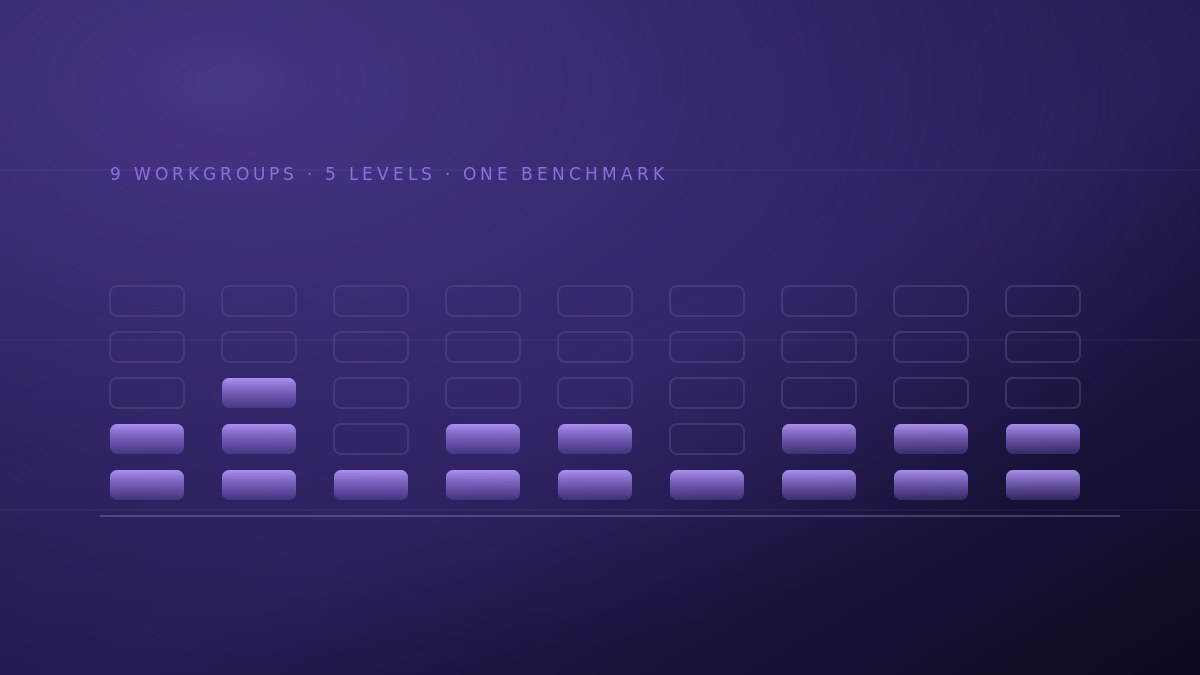
Nine workgroups scored against five anchors on a five-level scale, plotted against peer bands. The headline came out at level two, piloting, with value realization the anchor that capped eight of the nine.
A tooling map before any recommendation
Around forty AI tools mapped across the delivery lifecycle, showing where they overlap, where they are paid for twice and where nothing covers the step at all.
Four layers of certainty, stated openly
Every finding was labelled: frame, hypothesis, evidence, or live measurement. A board can act on a hypothesis if it knows it is one. The damage comes from a hypothesis presented as a measurement.
“Eight of nine teams were capped by the same anchor. Not by tools, not by skills, but by never measuring whether any of it produced value.”
The Method
Five parallel streams: governance and measurement, knowledge base, AI in the delivery lifecycle, adoption and culture, and agent deployment. Around twenty-five stakeholder interviews fed all of them.
The output was seven board deliverables plus a growth plan, presented to the board and then in a separate readout to the CEO. Included were the adoption benchmark, the tooling map, a cost and benefit model, a layered knowledge base blueprint with an evaluation method, and an open-weight model benchmark.
What this looks like in practice
On the infrastructure question the answer was the opposite of the one expected. The existing hardware already covered the entire development organization. The constraint was allocation, not capacity, so the recommendation was one additional node rather than a large capital programme.
What the Board Received
Only figures we produced are shown. The client's licence costs, headcount economics and internal usage data stay with the client.
Nine workgroups benchmarked on a five-level scale, with peer bands for context
Around forty AI tools mapped across the delivery lifecycle
Around twenty-five stakeholder interviews completed inside one month
Seven board deliverables plus a growth plan, presented to the board and to the CEO
Every finding labelled by certainty, from frame through hypothesis and evidence to live measurement
“The evaluation chain had four gates and only one of them was measured. That makes every existing score an upper bound, not a result.”
Why It Worked
The benchmark gave the organization one shared number per team. Before that, every department could argue it was ahead, because nobody had agreed what ahead means.
Labelling every finding by certainty made the material usable at board level. Nothing had to be hedged in the room, because the confidence was already written on the page.
The month was spent measuring rather than proposing. An organization that cannot say what it already has will buy more of it, and the honest first deliverable is a picture of the present, not a roadmap.
Want a similar transformation in your organization?
Let's talk about how Elevon can help your team too.
Book consultation